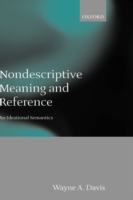
Nondescriptive Meaning and Reference An Ideational Semantics

Nondescriptive Meaning and Reference An Ideational Semantics

AngličtinaPevná vazbaTisk na objednávku
Davis Wayne A.
Oxford University Press
EAN: 9780199261659
Tisk na objednávku
Předpokládané dodání ve středu, 29. července 2026
4 253 Kč
Běžná cena: 4 725 Kč
Sleva 10 %
ks
Chcete tento titul ještě dnes?
knihkupectví Megabooks Praha Korunní
není dostupné
Librairie Francophone Praha Štěpánská
není dostupné
knihkupectví Megabooks Ostrava
není dostupné
knihkupectví Megabooks Olomouc
není dostupné
knihkupectví Megabooks Plzeň
není dostupné
knihkupectví Megabooks Brno
není dostupné
knihkupectví Megabooks Hradec Králové
není dostupné
knihkupectví Megabooks České Budějovice
není dostupné
knihkupectví Megabooks Liberec
není dostupné

Podrobné informace

Nondescriptive Meaning and Reference extends Wayne Davis's groundbreaking work on the foundations of semantics. Davis revives the classical doctrine that meaning consists in the expression of ideas, and advances the expression theory by showing how it can account for standard proper names, and the distinctive way their meaning determines their reference. He also shows how the theory can handle interjections, syncategorematic terms, conventional implicatures, and other cases long seen as difficult for both ideational and referential theories. The expression theory is founded on the fact that thoughts are event types with a constituent structure, and that thinking is a fundamental propositional attitude, distinct from belief and desire. Thought parts ('ideas' or 'concepts') are distinguished from both sensory images and conceptions. Word meaning is defined recursively: sentences and other complex expressions mean what they do in virtue of what thought parts their component words express and what thought structure the linguistic structure expresses; and unstructured words mean what they do in living languages in virtue of evolving conventions to use them to express ideas. The difficulties of descriptivism show that the ideas expressed by names are atomic or basic. The reference of a name is the extension of the idea it expresses, which is determined not by causal relations, but by its identity or content together with the nature of objects in the world. Hence a name's reference is dependent on, but not identical to, its meaning. A name is directly and rigidly referential because the extension of the idea it expresses is not determined by the extensions of component ideas. The expression theory thus has the strength of Fregeanism without its descriptivist bias, and of Millianism without its referentialist or causalist shortcomings. The referential properties of ideas can be set out recursively by providing a generative theory of ideas, assigning extensions to atomic ideas, and formulating rules whereby the semantic value of a complex idea is determined by the semantic values of its components. Davis also shows how referential properties can be treated using situation semantics and possible worlds semantics. The key is to drop the assumption that the values of intension functions are the referents of the words whose meaning they represent, and to abandon the necessity of identity for logical modalities. Many other pillars of contemporary philosophical semantics, such as the twin earth arguments, are shown to be unfounded.
EAN 9780199261659
ISBN 0199261652
Typ produktu Pevná vazba
Vydavatel Oxford University Press
Datum vydání 14. července 2005
Stránky 466
Jazyk English
Rozměry 242 x 165 x 31
Země United Kingdom
Autoři Davis Wayne A.
Ilustrace 4 tables, 2 line drawings
Informace o výrobci
Kontaktní informace výrobce nejsou momentálně dostupné online, na nápravě intenzivně pracujeme. Pokud informaci potřebujete, napište nám na [email protected], rádi Vám ji poskytneme.