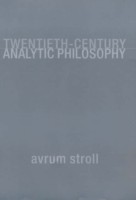
Twentieth-Century Analytic Philosophy

Twentieth-Century Analytic Philosophy

AngličtinaPevná vazba
Stroll Avrum
Columbia University Press
EAN: 9780231112208
Na objednávku
Předpokládané dodání v pondělí, 22. června 2026
2 841 Kč
Běžná cena: 3 157 Kč
Sleva 10 %
ks
Chcete tento titul ještě dnes?
knihkupectví Megabooks Praha Korunní
není dostupné
Librairie Francophone Praha Štěpánská
není dostupné
knihkupectví Megabooks Ostrava
není dostupné
knihkupectví Megabooks Olomouc
není dostupné
knihkupectví Megabooks Plzeň
není dostupné
knihkupectví Megabooks Brno
není dostupné
knihkupectví Megabooks Hradec Králové
není dostupné
knihkupectví Megabooks České Budějovice
není dostupné
knihkupectví Megabooks Liberec
není dostupné

Podrobné informace

Analytic philosophy is difficult to define since it is not so much a specific doctrine as a loose concatenation of approaches to problems. As well as having strong ties to scientism -the notion that only the methods of the natural sciences give rise to knowledge -it also has humanistic ties to the great thinkers and philosophical problems of the past. Moreover, no single feature characterizes the activities of analytic philosophers. Undaunted by these difficulties, Avrum Stroll investigates the "family resemblances" between that impressive breed of thinkers known as analytic philosophers. In so doing, he grapples with the point and purpose of doing philosophy: What is philosophy? What are its tasks? What kind of information, illumination, and understanding is it supposed to provide if it is not one of the natural sciences? Imbued with clarity, liveliness, and philosophical sophistication, Stroll's book presents a synoptic picture of the main developments in logic, philosophy of language, epistemology, and metaphysics in the past century. It does this by concentrating on the individual thinkers whose ideas have been most influential. Major themes in Twentieth-Century Analytic Philosophy include: * the innovation of mathematical logic by Gottlob Frege at the close of the nineteenth century and its independent development by Bertrand Russell; * the impact of advancements in science on the world of philosophy and its importance for understanding such doctrines as logical positivism, philosophy of language, philosophy of mind, and eliminative materialism; * the refusal by such thinkers as Wittgenstein, Moore, and Austin to treat logic as an ideal language superior to natural languages; and * a conjecture about which, if any, of the philosophers discussed in the book will enter the pantheon of philosophical gods. Along the way, Stroll also covers the theories of Rudolf Carnap, W. V. O. Quine, Gilbert Ryle, J. L. Austin, Hilary Putnam, Saul Kripke, John Searle, Ruth Marcus, and Patricia and Paul Churchland. Stroll's approach to his subject treats the critical movements in analytic philosophy in terms of the philosophers who defined them. The notoriously complex realm of analytic philosophy emerges less as an abstract enterprise than as a domain of personalities and their competing methods and arguments. The book's inventive presentations of complex logical doctrines relate them to the traditional problems of philosophy, seeking the continuity between them rather than polemical distinctions so as to bring the true differences of their respective achievements into sharper focus.
EAN 9780231112208
ISBN 0231112203
Typ produktu Pevná vazba
Vydavatel Columbia University Press
Datum vydání 3. července 2000
Stránky 304
Jazyk English
Rozměry 160 x 233 x 26
Země United States
Autoři Stroll Avrum
Informace o výrobci
Kontaktní informace výrobce nejsou momentálně dostupné online, na nápravě intenzivně pracujeme. Pokud informaci potřebujete, napište nám na [email protected], rádi Vám ji poskytneme.