

A profound literary meditation
Life in a world that changes faster than we do
A network of relationships and shared stories

Ripeness
British author Sarah Moss is one of those writers who can turn different life situations—ranging from the smallest to the most pivotal—into a deep literary reflection. Her prose style is recognisable after just a few sentences: lyrical, gentle, suffused with nature and melancholy. Although Moss was born in Scotland, she has been living for many years in Northern England and Ireland, and it is precisely these two landscapes—rainy and ever-changing—that take on as much importance in her book as the people. Her work is often labelled ‘eco-feminist’, but this label does it a disservice. Moss writes primarily about lives delicately embedded in the larger contexts of the world.
I fell in love with her previous novel, Summerwater, for its poeticism, sensitivity to the environment and the creation of a profound tension in the depiction of events over the course of a single day. While the reception from readers was not entirely positive, I felt that Moss demonstrated an exceptional sense for rhythm and a deep understanding of what remains unsaid. Her latest work, Ripeness, continues this poetic tone but adds something more: depth, calm, and maturity—both thematically and in terms of her craft.
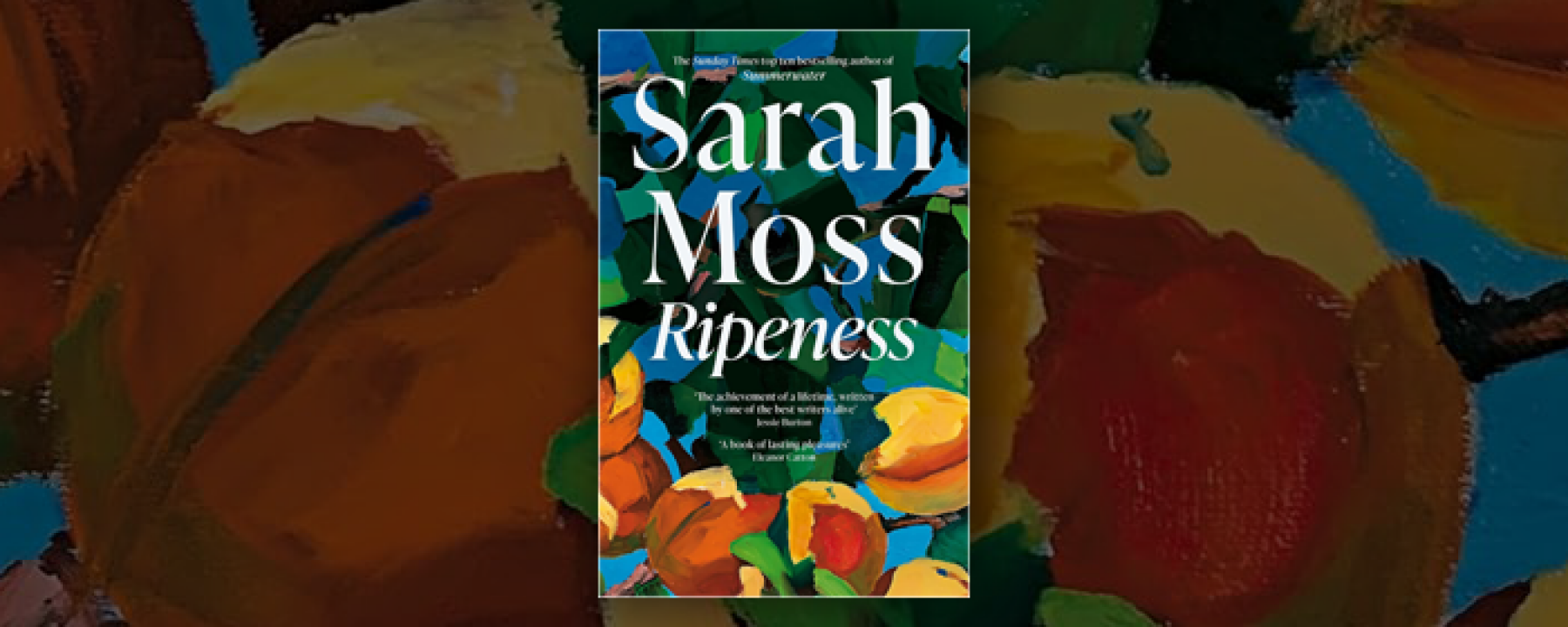
In Ripeness, we follow two timelines. The first introduces us to Edith as a seventeen-year-old girl spending a summer in the 1960s in an Italian villa with her pregnant sister Lydia, a ballerina determined to give her child up for adoption. In the second timeline, set fifty years later, we meet Edith again, now a mature, divorced woman living a quiet life in Ireland. On the surface these are two straightforward plotlines, in which you won’t find a story driven by a complicated plot, but rather a mosaic where each scene adds a new layer of meaning. The author expertly intertwines the personal maturation of the character with the natural cycle of the world—the changing seasons, the passage of time and society's evolution. The theme of ripeness (maturity) is present in every sense: physical, mental, natural and social.
Ballet, which plays a significant role in the novel, symbolises the fleetingness of life and serves as a metaphor for memory: What we do not speak of fades away, much like family stories. Only that which we are able to pass down from one generation to the next remains. This is also why Edith, towards the end of her life, writes to her sister’s child about the story of his birth and the circumstances surrounding it.
‘There’s no notation of ballet. It has to be passed on in real time, one living body to another. If a dancer dies without teaching the dance, the dance dies too.’
Alongside Edith’s personal story, Moss subtly develops social themes. The world facing global warming, as well as contemporary Ireland, marked by migration—both the outflow of Irish citizens and the influx of refugees seeking a new home. The author approaches these issues with admirable empathy—an empathy that in both her writing and her real life stems from her own roots. Both the author’s family and Edith’s ancestors experienced war and exile and struggled with the search for a new home. Moss rejects biological or national determinism. Rather than boundaries and family lines, she sees networks of relationships and shared stories.
‘There’s something Fascist, don’t you see, in the idea that your genes are your story? There are no border guards at the chambers of your heart.’
The author also reflects on her Jewish heritage. However, this is only subtly present, echoing in the ways the protagonist’s life resonates with traditions or how she deals with a legacy full of loss. Ripeness is not only about coming of age, but also about accepting old age—about the awareness that life is not linear, and that the past, as well as the fates of our ancestors, continually accompany us.

Ripeness
Moss SarahPan Macmillan
ISBN: 9781529035490
Na objednávku
Předpokládané dodání v pátek, 31. července 2026
498 Kč -10 %
Sarah Moss has succeeded in writing a book where time seems to stand still—yet at the same time, everything flows. Ripeness is a quiet, introspective, yet immensely layered novel, where human history, nature, politics and the metaphysics of everyday life converge. It’s a novel about what it means to belong somewhere. Here, the author achieves the literary maturity that she only hinted at in her previous work. Her style is refined and natural. Those expecting drama will find calm; those seeking certainty will find questions. But it is precisely in this that the strength of the work lies—in the quiet, yet persistent effort to understand what it means to be human in a world that changes faster than we do.
Ripeness is not just a novel about maturation. It is a novel that ripens through reading—and the longer you stay in it, the more it delights.
Podobné články




Tento článek pro vás připravil

Získávejte nejnovější informace, aktuality nebo slevy na knížky na váš e-mail. Odesláním vašeho e-mailu souhlasíte s marketingovou komunikací: