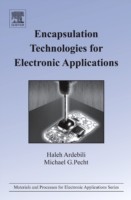
Encapsulation Technologies for Electronic Applications

Encapsulation Technologies for Electronic Applications

EnglishHardbackPrint on demand
Ardebili Haleh
William Andrew Publishing
EAN: 9780815515760
Print on demand
Delivery on Monday, 17. of August 2026
CZK 5,035
Common price CZK 5,594
Discount 10%
pc
Do you want this product today?
Megabooks Praha Korunní
not available
Librairie Francophone Praha Štěpánská
not available
Megabooks Ostrava
not available
Megabooks Olomouc
not available
Megabooks Plzeň
not available
Megabooks Brno
not available
Megabooks Hradec Králové
not available
Megabooks České Budějovice
not available
Megabooks Liberec
not available

Detailed information

Electronics are used in a wide range of applications including computing, communication, biomedical, automotive, military and aerospace. They must operate in varying temperature and humidity environments including indoor controlled conditions and outdoor climate changes. Moisture, ionic contamination, heat, radiation and mechanical stresses are all highly detrimental to electronic devices and can lead to device failures. Therefore, it is essential that the electronic devices be packaged for protection from their intended environments, as well as to provide handling, assembly, electrical and thermal considerations. Currently, more than 99% of microelectronic devices are plastic encapsulated. Improvements in encapsulant materials, and cost incentives have stretched the application boundaries for plastic electronic packages. Many electronic applications that traditionally used hermetic packages such as military are now using commercial-off-the-shelf (COTS) plastic packages. Plastic encapsulation has the advantages of low cost, smaller form factors, and improved manufacturability. With recent trends in environmental awareness, new environmentally friendly or ' green' encapsulant materials (i.e. without brominated additives) have emerged. Plastic packages are also being considered for use in extreme high and low temperature electronics. 3-D packaging and wafer-level-packaging (WLP) require unique encapsulation techniques. Encapsulant materials are also being developed for micro-electro-mechanical systems (MEMS), bio-MEMS, bio-electronics, and organic light-emitting diodes (O-LEDs). This book offers a comprehensive discussion of encapsulants in electronic applications. The main emphasis is on the encapsulation of microelectronic devices; however, the encapsulation of connectors and transformers is also addressed. This book discusses 2-D and 3-D packaging and encapsulation, encapsulation materials including environmentally friendly 'green' encapsulants, and the properties and characterization of encapsulants. Furthermore, this book provides an extensive discussion on defects and failures related to encapsulation, how to analyze such defects and failures, and how to apply quality assurance and qualification process for encapsulated packages. This book also provides information on the trends and challenges of encapsulation and microelectronic packages including application of nanotechnology.
EAN 9780815515760
ISBN 0815515766
Binding Hardback
Publisher William Andrew Publishing
Publication date July 22, 2009
Pages 504
Language English
Dimensions 229 x 152
Country United States
Readership Professional & Scholarly
Authors Ardebili Haleh; Pecht Michael G.
Series Materials and Processes for Electronic Applications
Manufacturer information
The manufacturer's contact information is currently not available online, we are working intensively on the axle. If you need information, write us on [email protected], we will be happy to provide it.