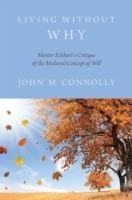
Living Without Why

Living Without Why

EnglishHardbackPrint on demand
Connolly John M.
Oxford University Press Inc
EAN: 9780199359783
Print on demand
Delivery on Tuesday, 1. of September 2026
CZK 2,541
Common price CZK 2,823
Discount 10%
pc
Do you want this product today?
Megabooks Praha Korunní
not available
Librairie Francophone Praha Štěpánská
not available
Megabooks Ostrava
not available
Megabooks Olomouc
not available
Megabooks Plzeň
not available
Megabooks Brno
not available
Megabooks Hradec Králové
not available
Megabooks České Budějovice
not available
Megabooks Liberec
not available

Detailed information

What does it mean to "live without why"? This was the advice of Meister Eckhart (ca. 1260-1328), both in his Latin treatises to philosophers and theologians and in his German sermons to nuns and ordinary lay persons. He seems to have meant that we should live and act out of justice or goodness and not in order to gain some reward for our deeds. This message was received with indignation by the Church hierarchy and was condemned by the Pope in 1329. How did Eckhart come to formulate it? And why was it so controversial? John M. Connolly addresses these questions by locating Eckhart's thinking about how to live within the mainstream synthesis of Christian and classical thought formulated in the High Middle Ages. He calls the classical Greek moral consensus "teleological eudaimonism," according to which correct living coincides with the attainment of happiness (eudaimonia). This involves living a life marked by the practice of the virtues, which in turn requires a consistent desire for the correct goal in life. This desire is the core notion of will. In late antiquity Augustine drew on this tradition in formulating his views about how Christians should live. This required grafting onto classical eudaimonism a set of distinctively scriptural notions such as divine providence, original sin, redemption, and grace. In the 13th century these ideas were systematized by Thomas Aquinas in his will-centered moral theology. Eckhart claimed that this tradition was profoundly mistaken. Far from being a wild-eyed mystic or visionary, he argued trenchantly from classical philosophical principles and the Christian scriptures. Connolly proposes that Eckhart's views, long obscured by the papal condemnation, deserve reconsideration today. "This book is a signal contribution to ancient and medieval philosophy. By putting Eckhart into conversation with his predecessors (i.e., Aristotle, Augustine, and Aquinas), Connolly does a fine job in identifying where Eckhart makes an original-and still viable-contribution to moral thought in general. This is a remarkable work, the product of long and careful thought, as well as being clearly presented. " -Bernard McGinn, Naomi Shenstone Donnelley Professor Emeritus of Historical Theology and of the History of Christianity in the Divinity School and the Committees on Medieval Studies and on General Studies, University of Chicago "It would appear that Connolly has written the right book at the right moment. Through his work, the English-speaking world can become finally acquainted with the academic discussion of the last decades concerning Eckhart and can furthermore have an original and text grounded interpretation of a relevant section of his philosophical thought." -Loris Sturlese, Professor of Medieval Philosophy, Università del Salento
EAN 9780199359783
ISBN 0199359784
Binding Hardback
Publisher Oxford University Press Inc
Publication date August 21, 2014
Pages 256
Language English
Dimensions 236 x 157 x 25
Country United States
Authors Connolly John M.
Manufacturer information
The manufacturer's contact information is currently not available online, we are working intensively on the axle. If you need information, write us on [email protected], we will be happy to provide it.