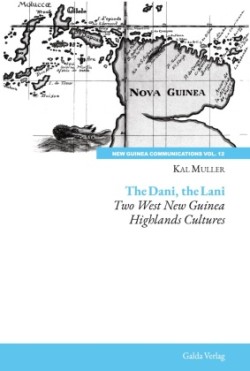
Dani, the Lani

Dani, the Lani

EnglishPaperback / softback
Muller, Kal
Galda Verlag
EAN: 9783962032630
On order
Delivery on Friday, 28. of August 2026
CZK 1,297
Common price CZK 1,441
Discount 10%
pc
Do you want this product today?
Megabooks Praha Korunní
not available
Librairie Francophone Praha Štěpánská
not available
Megabooks Ostrava
not available
Megabooks Olomouc
not available
Megabooks Plzeň
not available
Megabooks Brno
not available
Megabooks Hradec Králové
not available
Megabooks České Budějovice
not available
Megabooks Liberec
not available

Detailed information

THE BOOKThe Dani group, centered in the Baliem Valley, has long taken the world's attention. It is by far the best-known ethnic group in West New Guinea, ever since its discovery by the aptly named American explorer Richard Archbold in 1938. While some Dutch groups had passed close by during previous nears, none had seen the valley itself with its high population of 50,000 to 100,000. The flat, fertile valley bottom was expertly farmed with irrigation and drainage in geometrically laid out fields of raised mounds that produced bumper crops of sweet potatoes. The Dani group was discovered when Archbold flew his hydroplane overhead and was suitably impressed by the gardens beautiful, orderly layout. He also saw some mysterious tall erections dispersed in several areas on the flat land. These structures turned out to be watchtowers, ready to alert the nearby inhabitants of the approach of a hostile group. For large-scale warfare was the way of life in the Baliem. Divided into several large alliances, hostilities were never-ending, punctured by short periods of relative peace. After the Archbold Expedition left the valley, the next visitors were American Evangelical missionaries who landed on the Baliem River in their new hydroplane. They established a base there and began proselytizing a full two years before the Dutch opened their first post there. A few years later, an American filming expedition from Harvard University was able to film the daily life as well as some actual battles, fought with spears, bows and arrows. The film, Dead Birds, was screened to many audiences in the US and elsewhere. The missionaries among the Dani were not very successful. This was in stark contrast with the Lani (also called Western Dani) who lived in the northernmost part of the Baliem Valley and spread far toward the east in West New Guinea's central highlands. They had been successfully proselytized by American Evangelicals based in Enarotali, on the shore of Lake Paniai. The Lani had migrated from the east towards the west probably due to population pressures and thinly inhabited lands. They had not been satisfied by their traditional religion that did not provide material goods such as those enjoyed by the missionaries. After only a few years, they became Christians and burned their old fetiches to show their commitment to the new religion. THE SERIESThe aim is to provide a conduit for the publication of studies on the Island of New Guinea, with its two established political divisions, but will also include other associated patterns of islands.It will enable contributions from new knowledge workers-with their dissertations-and from established scholars. As there are numerous scholars who would like better coverage of the areas in which they have explored-as a tribute to the people they have worked with-as well as local scholars who understand the importance of their unique areas. It is felt that the approaches being trialed in the visual anthropology part of the series as area studies will bring a wider attention to the remarkable nature of the island.The first volumes will be on modes of communication: oral history and folklore, and the emergence of a local literature. While the representation of all disciplines is welcome, comparative and whole island studies would be of great interest as well. For this, collaborative works or edited volumes may be needed.It will allow for academic publications of a more preliminary kind-rather than exhaustive monographs, which are becoming more and more impossible to produce.Where is the knowledge we have lost?
EAN 9783962032630
ISBN 3962032630
Binding Paperback / softback
Publisher Galda Verlag
Publication date March 10, 2023
Pages 264
Language English
Dimensions 234 x 156 x 14
Authors Muller, Kal
Series New Guinea Communications, Volume 12
Manufacturer information
The manufacturer's contact information is currently not available online, we are working intensively on the axle. If you need information, write us on [email protected], we will be happy to provide it.