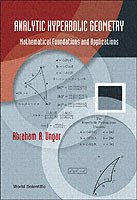
Analytic Hyperbolic Geometry: Mathematical Foundations And Applications

Analytic Hyperbolic Geometry: Mathematical Foundations And Applications

EnglishHardback
Ungar Abraham Albert
World Scientific Publishing Co Pte Ltd
EAN: 9789812564573
On order
Delivery on Tuesday, 21. of July 2026
CZK 4,185
Common price CZK 4,650
Discount 10%
pc
Do you want this product today?
Megabooks Praha Korunní
not available
Librairie Francophone Praha Štěpánská
not available
Megabooks Ostrava
not available
Megabooks Olomouc
not available
Megabooks Plzeň
not available
Megabooks Brno
not available
Megabooks Hradec Králové
not available
Megabooks České Budějovice
not available
Megabooks Liberec
not available

Detailed information

This is the first book on analytic hyperbolic geometry, fully analogous to analytic Euclidean geometry. Analytic hyperbolic geometry regulates relativistic mechanics just as analytic Euclidean geometry regulates classical mechanics. The book presents a novel gyrovector space approach to analytic hyperbolic geometry, fully analogous to the well-known vector space approach to Euclidean geometry. A gyrovector is a hyperbolic vector. Gyrovectors are equivalence classes of directed gyrosegments that add according to the gyroparallelogram law just as vectors are equivalence classes of directed segments that add according to the parallelogram law. In the resulting “gyrolanguage” of the book one attaches the prefix “gyro” to a classical term to mean the analogous term in hyperbolic geometry. The prefix stems from Thomas gyration, which is the mathematical abstraction of the relativistic effect known as Thomas precession. Gyrolanguage turns out to be the language one needs to articulate novel analogies that the classical and the modern in this book share.The scope of analytic hyperbolic geometry that the book presents is cross-disciplinary, involving nonassociative algebra, geometry and physics. As such, it is naturally compatible with the special theory of relativity and, particularly, with the nonassociativity of Einstein velocity addition law. Along with analogies with classical results that the book emphasizes, there are remarkable disanalogies as well. Thus, for instance, unlike Euclidean triangles, the sides of a hyperbolic triangle are uniquely determined by its hyperbolic angles. Elegant formulas for calculating the hyperbolic side-lengths of a hyperbolic triangle in terms of its hyperbolic angles are presented in the book.The book begins with the definition of gyrogroups, which is fully analogous to the definition of groups. Gyrogroups, both gyrocommutative and non-gyrocommutative, abound in group theory. Surprisingly, the seemingly structureless Einstein velocity addition of special relativity turns out to be a gyrocommutative gyrogroup operation. Introducing scalar multiplication, some gyrocommutative gyrogroups of gyrovectors become gyrovector spaces. The latter, in turn, form the setting for analytic hyperbolic geometry just as vector spaces form the setting for analytic Euclidean geometry. By hybrid techniques of differential geometry and gyrovector spaces, it is shown that Einstein (Möbius) gyrovector spaces form the setting for Beltrami-Klein (Poincaré) ball models of hyperbolic geometry. Finally, novel applications of Möbius gyrovector spaces in quantum computation, and of Einstein gyrovector spaces in special relativity, are presented.
EAN 9789812564573
ISBN 9812564578
Binding Hardback
Publisher World Scientific Publishing Co Pte Ltd
Publication date September 7, 2005
Pages 484
Language English
Dimensions 232 x 156 x 30
Country Singapore
Authors Ungar Abraham Albert
Manufacturer information
The manufacturer's contact information is currently not available online, we are working intensively on the axle. If you need information, write us on [email protected], we will be happy to provide it.